
Social media is full of “before/after” miracles: rub in castor oil, use a biotin shampoo, and wake up with thick hair. But when you are dealing with real hair thinning, do these quick, viral fixes actually work?
Spoiler alert: Mostly, no. While a few of these trends have limited supportive evidence for scalp health, they rarely produce meaningful hair regrowth. Viral products might temporarily improve how your hair feels or add surface volume, but they simply cannot address the true root causes of hair loss, such as hormones, genetics, or hidden inflammation.
Below, we break down the noise with a clear Myth vs. Reality guide, a quick evidence scorecard based on 2025–2026 research, and explain why a personalized, trichology-guided approach beats a viral trend every single time.
Myth vs. Reality Table: Oils & Shampoos for Hair Loss
| Myth / Viral Claim | Reality / What Studies Show (2025–2026) | Verdict | Bottom Line for You |
|---|---|---|---|
| Castor oil regrows hair & thickens bald spots | No strong human clinical evidence for regrowth. Excellent moisturizer (reduces dryness/breakage). | Mostly Myth | Good for conditioning brittle hair, but not a follicle stimulator. |
| Rosemary oil = minoxidil-level regrowth | Small 2015 study + recent reviews (2025) show similar hair count gains to 2% minoxidil in some users. Limited large-scale data; not a full replacement. | Partial Truth (Promising but Limited) | May help mildly via circulation/anti-inflammation; dilute properly. |
| Biotin shampoos/supplements stop loss & regrow | Only helps if deficient (rare). Topical absorption poor; no strong evidence for normal people. | Mostly Myth | Supports nail/hair strength if low biotin, but won't reverse pattern loss. |
| Caffeine shampoos block DHT & grow hair | Lab/animal studies show potential; small human trials suggest minor benefits. Shampoo contact time too short for real impact. | Partial Truth (Weak) | Better in leave-on serums; shampoos mainly clean scalp. |
| "Natural" is always safe & more effective | Can irritate/clog; many lack rigorous testing. Proven treatments have more data. | Myth | "Natural" ≠ effective. Patch test & consult for safety. |
| Any "hair growth shampoo" reverses thinning | Surface cleaning + temporary volume. Can't reach follicles or block hormones deeply. | Mostly Myth | Supports hygiene (important first step), but not regrowth on its own. |
Quick Evidence Scorecard (1–10 Scale)
If we rate these viral trends based purely on their ability to regrow lost hair, here is how they score:
- Castor oil: 2/10 (Moisturizing? Yes. Growth? No.)
- Rosemary oil: 5/10 (Some small-study promise, but more robust research is needed.)
- Biotin shampoo: 2/10 (Useless for genetic loss; only helps if you have a rare deficiency.)
- General "growth" shampoos: 3/10 (Great for scalp hygiene, not a medical treatment.)
- Castor oil: 2/10 (Moisturizing? Yes. Growth? No.)
What the Latest Research Says (2025–2026)
- Rosemary oil : Recent dermatological reviews confirm that small trials (like the famous 2015 study published in the National Library of Medicine) show comparable results to low-dose minoxidil in some mild cases of pattern loss. However, trichologists warn there is still limited large-scale, long-term data.
- Caffeine : While lab evidence is strong for caffeine stimulating the follicle, human shampoo studies remain weak because the product simply washes down the drain before it can penetrate.
- Biotin : The scientific consensus remains firm in 2026. According to the American Academy of Dermatology (AAD), there is no proven benefit for hair regrowth from biotin in healthy individuals unless a specific blood deficiency is present.
- Castor oil : No solid regrowth evidence; mainly conditioning.
Beyond Myths: The Real Path to Hair Health
Hype sells bottles, but lasting results come from understanding your unique causes (hormones, inflammation, circulation, genetics). Surface products rarely reach deep enough.
The real path to restoration starts with:
- Advanced Scalp Analysis: Using modern imaging to map your exact follicle health.
- Targeted Non-Surgical Support: Utilizing therapies with heavy clinical backing, like Low-Level Light Therapy (LLLT) for stimulation, advanced growth-factor infusions for cellular nutrition, or SMP for the illusion of density.
- Data Tracking: Using real progress photos and microscopic measurements, not just guessing in the mirror.
Pro Tip: How to Use Viral Products Safely If you still want to try scalp oils, follow these rules: Always dilute essential oils (like rosemary) in a carrier oil (like jojoba). Do a 24-hour patch test. Use them a maximum of 2 to 3 times per week to avoid suffocating the follicle, and stop immediately if your scalp gets itchy or red. Combine them with proven treatments, rather than relying on them as a cure.
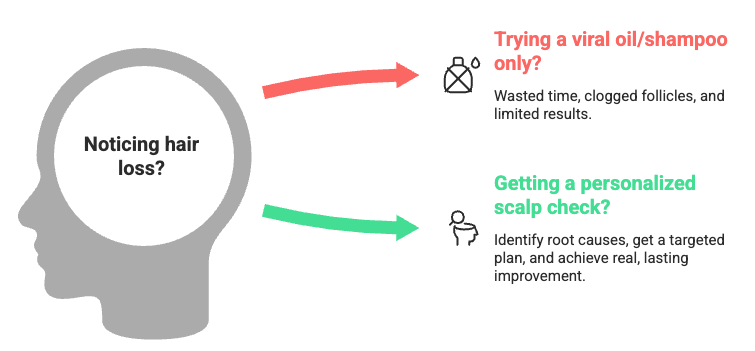
Quick Decision Tree
Tired of the endless trial and error loop? Here is the most efficient way to handle hair thinning:
Frequently Asked Questions
Can I mix natural oils or shampoos with real medical treatments?
Yes, many complement each other beautifully. For example, using a gentle clarifying shampoo creates a clean scalp environment before applying a proven topical or using an LLLT device. Just avoid heavy oils that clog pores.
Why do some people online swear they see results from these products?
It is usually a mix of factors: better general scalp hygiene, moisturizing the hair shaft (which reduces breakage and makes hair look fuller), the placebo effect, or they are secretly using proven clinical treatments alongside the oils.
Is rosemary oil safe for daily use?
If properly diluted, yes. Undiluted essential oils can cause severe chemical burns or contact dermatitis.
What's the biggest mistake people make with viral hair products?
Relying on them as a standalone "cure" while ignoring the underlying root causes (like hormones or nutritional gaps) until the hair loss becomes much harder to treat.
How do I spot real evidence versus internet hype?
Look for large human trials (not just lab or animal studies), realistic timelines (real hair takes 3 to 6 months to grow, not 2 weeks), and professional backing from organizations like the International Society of Hair Restoration Surgery (ISHRS).
Tired of trial-and-error? A clear scalp evaluation cuts through the myths and shows what truly fits your hair.